Cutting resolution time with AI inside ServiceNow
Where generative AI actually moves the needle on service management metrics.
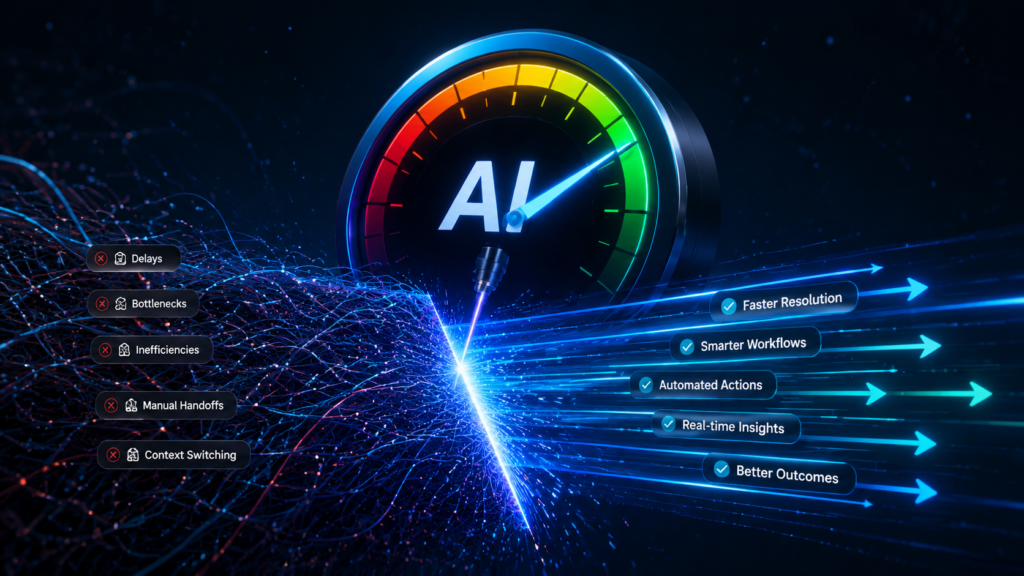
IT teams handle thousands of requests, incidents and repeat questions every day. Traditional ITSM gives that work structure — but structure isn’t speed. Most of the elapsed time on a ticket isn’t spent solving the problem. It’s spent understanding it, routing it, and re-explaining it.
That’s the part AI is genuinely good at, and it’s where the measurable gains sit.
Where the time actually goes
Before automating anything, look at how a ticket’s life is really spent. In most service desks it breaks down into four stages, and only one of them is technical work:
- Interpretation — reading a vague description and working out what’s actually wrong
- Routing — deciding which team owns it, and being wrong often enough that reassignment is normal
- Context rebuilding — every handover starts with someone re-reading the whole thread
- Resolution — the actual fix
Triage and routing: the fastest win
Classification is the highest-value place to start, because misrouting is expensive twice — once in the delay, once in the second person’s time.
A model reading the description, the requester’s role, their asset record and the recent change history can assign category, urgency and group more consistently than a queue manager working at volume. It doesn’t get tired at 4pm, and it applies the same logic to ticket 900 as to ticket 9.
Two conditions make it work: route to groups rather than individuals, and keep a confidence threshold below which it goes to a human instead of guessing.
Summarisation at every handover
This is the least glamorous improvement and often the most felt. Every escalation, shift change and reassignment currently begins with someone reading a long thread to reconstruct what happened.
An automatic summary — what was reported, what’s been tried, what’s outstanding — turns a five-minute read into a fifteen-second one. Multiply that by every handover in a week and it’s a larger number than most of the headline automations.
Knowledge that stays current
Most knowledge bases fail the same way: articles are written once, drift out of date, and stop being trusted. Once agents stop trusting them they stop searching them, and the KB decays further.
AI helps at both ends. It surfaces the relevant article at the moment of need instead of relying on keyword search, and it drafts new articles from resolved incidents so the knowledge exists at all. The draft still needs a human to approve it — but drafting was always the reason nobody wrote them.
Deflection, carefully
Self-service deflection gets the attention because it removes tickets entirely. It’s also where AI most visibly fails when it’s rushed — a confidently wrong answer to a password reset costs more trust than it saves time.
Start with the narrow, high-volume, low-risk requests where the answer is unambiguous. Earn the right to widen the scope. And make the escape hatch to a human obvious on every interaction — deflection that traps people isn’t deflection, it’s a complaint queue forming somewhere else.
How the pieces fit together
The strongest implementations don’t treat these capabilities as separate AI features. They connect them to the existing service workflow, with human review where confidence is low and clear controls around what the model can do.
                         EXISTING ITSM
                    ┌─────────────────────┐
                    │      SERVICENOW     │
                    │                     │
                    │  Incidents         │
                    │  Requests          │
                    │  Changes           │
                    │  User / Asset Data │
                    └──────────┬──────────┘
                               │
                               ▼
                    ┌─────────────────────┐
                    │    AI ORCHESTRATOR  │
                    │                     │
                    │ Context + Policies  │
                    │ Confidence Checks   │
                    │ Workflow Control    │
                    └──────────┬──────────┘
                               │
          ┌────────────────────┼────────────────────┐
          │                    │                    │
          ▼                    ▼                    ▼
┌──────────────────┐ ┌──────────────────┐ ┌──────────────────┐
│ AI TRIAGE        │ │ AI SUMMARISATION │ │ AI KNOWLEDGE     │
│                  │ │                  │ │                  │
│ Category         │ │ Ticket history   │ │ Search KB        │
│ Urgency          │ │ What was tried   │ │ Find sources     │
│ Assignment group │ │ Current status   │ │ Draft articles   │
│ Confidence       │ │ Next action      │ │ Human approval   │
└────────┬─────────┘ └────────┬─────────┘ └────────┬─────────┘

                 GUARDRAILS ACROSS THE SYSTEM
       ─────────────────────────────────────────────
       Confidence threshold • Human escalation
       Source attribution • Audit logging
       Access controls • Feedback loop
The architecture is deliberately simple: AI sits around the existing service workflow rather than replacing it. The model can classify, summarise, retrieve knowledge and handle narrow requests, while confidence thresholds and human review keep uncertain cases inside the normal support process.
What to measure
Mean time to resolution is the headline, but on its own it’s easy to move for the wrong reasons. Track it alongside:
- Reassignment rate — the honest test of whether routing improved
- First-contact resolution — did it get solved, or just moved
- Reopen rate — fast closures that come back aren’t wins
- Deflection accuracy, not deflection volume — how many self-service answers were actually correct
- Agent satisfaction — the people doing the work notice degradation before the dashboard does
A ticket closed quickly and reopened next week hasn’t been resolved. It’s been deferred.
The pattern that works is unglamorous: pick the stage where time is genuinely lost, apply AI narrowly, measure honestly, then widen. The teams who try to automate resolution before they’ve fixed triage tend to end up with a faster route to the wrong answer.
If you’re weighing where AI fits in your ServiceNow estate, start a conversation. You’ll be talking to the people who do the work.

Buy, build, or integrate: an AI decision framework for leaders
How to decide where to invest — and where to wait — across an AI roadmap.

Putting Claude into production: what actually breaks, and how to prevent it
The gap between a convincing demo and a system you can trust at scale is mostly engineering discipline. Here's the checklist we run on every deployment.

Claude to anything: patterns for connecting AI to your stack
MCP, secure APIs and the integration patterns that keep AI close to your data.